What the Urine Anion Gap Measures
The urine anion gap is a computed value that can estimate how much urinary ammonium the kidneys are excreting. As ammonium is one of the main ways the body removes acid, this number provides useful information about acid-base balance and kidney function. It is frequently used in a metabolic evaluation when clinicians are trying to understand why a person has an abnormal acid-base result.
Unlike a direct measurement, the urine anion gap is a diagnostic marker derived from urine electrolytes. It uses urine sodium, urine potassium, and urine chloride to offer a clue about renal acid excretion. In simple terms, it helps answer whether the kidneys are responding as expected to acid buildup.
This test is particularly helpful in an acid-base disorder with low bicarbonate, where the key question is whether the problem is due to the kidneys or to some other cause such as gastrointestinal bicarbonate loss. It supports the differential diagnosis of non-anion gap acidosis and helps interpret a broader lab result in clinical context.
Typical Urine Anion Gap Range
The expected urine anion gap range is usually considered to be around zero, often somewhere around -20 to +20 mEq/L depending on the testing laboratory and medical setting. This is considered as a reference interval, not a one fixed value. Different testing methods, sample conditions, and patient factors can alter the expected range slightly.
A negative value is often interpreted as appropriate when the kidneys are excreting more ammonium. A positive value can suggest reduced ammonium excretion, though the meaning depends on the full clinical context. For that reason, the urine anion gap should never be read in isolation.
In practical terms, a negative urine anion gap usually points toward intact renal acid handling, while a positive urine anion gap may suggest impaired renal response. These are general patterns, not absolute rules. The final clinical interpretation depends on symptoms, other labs, and the reason the urine test was ordered.
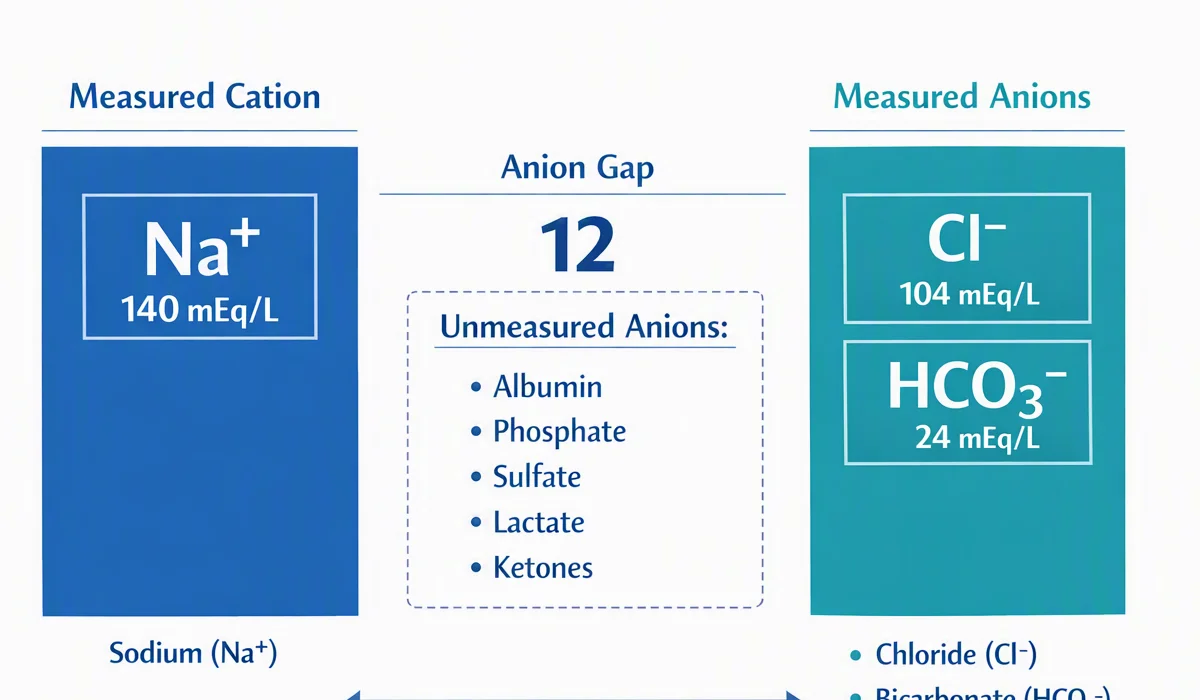
It is also important to separate this from the serum anion gap. The serum version helps evaluate acid accumulation in blood, while the urine anion gap focuses on electrolyte excretion and kidney acid handling. They serve separate purposes, even though the names sound similar.
How to Work Out the Urine Anion Gap
The urine anion gap is calculated using a simple formula:
Urine anion gap = urine sodium + urine potassium - urine chloride
To use the formula, you need the values for sodium, potassium, and chloride from the same spot urine sample. The result is a calculated value that estimates whether unmeasured positively charged substances, especially ammonium, are being excreted in the urine.
Here is a basic example. If urine sodium is 40, urine potassium is 20, and urine chloride is 70, then the urine anion gap is:
40 + 20 - 70 = -10
That negative result often suggests greater ammonium excretion. The calculation is straightforward, but the interpretation depends on https://anion-gap-analyzer282.urbanvellum.com/posts/could-fasting-affect-the-anion-gap the clinical setting, such as whether the person has metabolic acidosis or another acid-base disorder.
Because the test uses routine urine electrolytes, it is often available during a routine metabolic workup. Even so, the numeric result is only one element of the story. The surrounding context, including urine sodium, urine potassium, and urine chloride, matters for accurate interpretation.
Understanding a Negative, Neutral, or Positive Reading Means
A clearly negative urine anion gap often indicates that the kidneys are removing ammonium properly. This finding is frequently seen when the body is adapting to acid load in a healthy way. Often, it points against impaired renal acid excretion.
A standard result near zero can be more difficult to interpret on its own. It may represent a balanced state, or it may occur when several factors offset one another. This is why the urine anion gap is best viewed as a clue rather than a final diagnosis.
A notably high result can suggest decreased ammonium production or decreased ammonium excretion. This is significant in practice in metabolic acidosis, because the kidneys should usually increase acid removal. If they fail to do so, clinicians may consider renal tubular acidosis or other kidney-related causes.
One of the most common uses of the urine anion gap is distinguishing renal causes from gastrointestinal causes such as diarrhea. In diarrhea, the body often loses bicarbonate through the GI tract, and the kidneys typically respond by increasing ammonium excretion. That response often leads to a negative urine anion gap. By contrast, in renal tubular acidosis, ammonium excretion is often impaired, which may produce a positive value.
In this way, the urine anion gap becomes a helpful clue in the evaluation of metabolic acidosis with low bicarbonate. It helps focus the differential diagnosis and supports a more focused assessment of kidney acid handling.
Restrictions of the Urine Anion Gap
While helpful, the urine anion gap has major limits. It is commonly calculated from a spot urine sample, which represents one moment in time rather than a full day of excretion. Level of hydration, recent diet, medications, and other factors can alter the result.
The test also depends on precise electrolyte measurement. Small errors in urine sodium, urine potassium, or urine chloride can affect the final value. Because of this, the result should be assessed thoughtfully and always alongside the remaining workup.
Another limitation is that the urine anion gap is an indirect estimate of ammonium, not a direct one. In some situations, the urine osmolal gap may provide a more accurate estimate of ammonium excretion. That alternative calculation can sometimes be more helpful when the urine anion gap is less reliable.
Clinical interpretation also varies depending on the setting. A result that looks abnormal in one patient may be expected in another, especially if kidney function is changing or if urine composition is altered by illness or treatment. For that reason, the urine anion gap should support, not replace, the broader clinical assessment.
How the Anion Gap Calculator Can Support
The Anion Gap Calculator can make easier simplify the process of examining electrolyte values and understanding a related calculation tool. While many people use it for serum analysis, it can also aid broader educational understanding of how an anion gap is derived and why result interpretation matters.
For someone reviewing urine testing, a calculator can reinforce the relationship between input values and the final number. It helps make the formula easier to understand and can limit mistakes when comparing urine sodium, urine potassium, and urine chloride. That makes it a useful companion for anyone learning how the urine anion gap fits into clinical reasoning.
The biggest benefit is precision. A calculated value is simpler to trust when you see how it was created. The Anion Gap Calculator can also help users relate the number with likely meanings, such as a negative urine anion gap suggesting greater ammonium excretion, or a positive value raising concern for impaired renal acid handling.
Still, no calculator can replace proper result interpretation. Numbers must be viewed alongside symptoms, medical history, and lab findings. The NAGMA causes goal is not just computation, but meaningful clinical interpretation.
When to Seek Medical Evaluation
A urine anion gap result is most useful when it is part of a wider assessment. You should arrange an assessment if you have symptoms suggesting an acid-base problem, significant dehydration, or signs of worsening kidney disease. Symptoms may include low energy, rapid breathing, confusion, nausea, or ongoing digestive losses.
Medical testing becomes especially important if blood work shows low bicarbonate, unexplained metabolic acidosis, or abnormal kidney-related values. In those situations, the urine anion gap may help identify the cause, but it should be paired with other medical testing to provide a complete picture.
People with known kidney disease or possible tubular problems may also need closer follow-up. The kidneys play a major role in acid-base status, so changes in kidney function can alter ammonium excretion and the urine anion gap. If symptoms are persistent or severe, prompt assessment is the safest approach.
Frequently Asked Questions
What range is considered normal for the urine anion gap?
The normal urine anion gap range is generally around zero, often around -20 to +20 mEq/L, though exact reference values can vary depending on the lab and patient context. A slightly negative result is often considered expected.
Is a negative urine anion gap considered normal?
Yes, a negative urine anion gap is often normal and usually suggests that the kidneys are excreting ammonium appropriately. In the right setting, it indicates adequate renal acid excretion.
How do you work out the urine anion gap?
You calculate it with the formula: urine sodium + urine potassium - urine chloride. This uses urine electrolytes from a spot urine sample and gives a calculated value that helps estimate urinary ammonium.
What does a positive urine anion gap mean?
A positive urine anion gap can suggest reduced ammonium excretion, which may point toward impaired kidney acid handling. It is often considered in metabolic acidosis and may raise concern for renal tubular acidosis, though the full clinical context matters.
When do clinicians check the urine anion gap?
The urine anion gap is often checked during a workup for metabolic acidosis, especially when the cause is unclear. It can help distinguish kidney-related causes from causes such as diarrhea and supports broader clinical interpretation of acid-base status.